December 18th, 2019
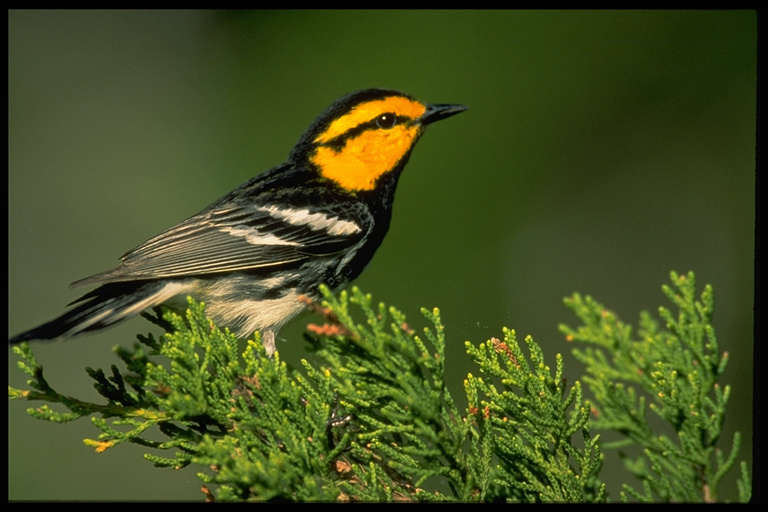
Golden-cheeked warbler
This is Passport to Texas
Hear that? That’s the Golden-cheeked warbler.
The Golden-cheeked Warbler is only in about 33 counties of Texas. It breeds nowhere else on the planet.
Texas Parks and Wildlife state ornithologist Cliff Shackelford says we can be very proud that this bird is endemic to Texas. But the Golden-cheeked Warbler remains on the federal endangered species list.
It’s been on the list for quite some time. There’s been talk about revisiting that. The data we have suggests that it’s fairly stable but not on a huge incline. There’s still a lot of challenges.
Challenges like the expanding human population into the Texas Hill Country. All too often the tall stands of Ashe-juniper and oak trees Golden-cheeked Warblers depend on are completely removed for development. But preserving native vegetation benefits both the species and the landowner.
Property value is greater when you leave old trees. When we leave that habitat we’re also protecting those hillsides from erosion. You’ve got vegetation holding the soil together. And so you’re not just leaving the habitat for this bird, you’re also helping your property in general.
Sounds like a win-win Cliff.
The Wildlife Restoration Program supports our series and funds Golden-cheeked Warbler research in Texas.
For Texas Parks and Wildlife…I’m Cecilia Nasti.
Posted in Birding, Conservation | Comments Off on Consider the Golden-Cheeked Warbler
December 17th, 2019
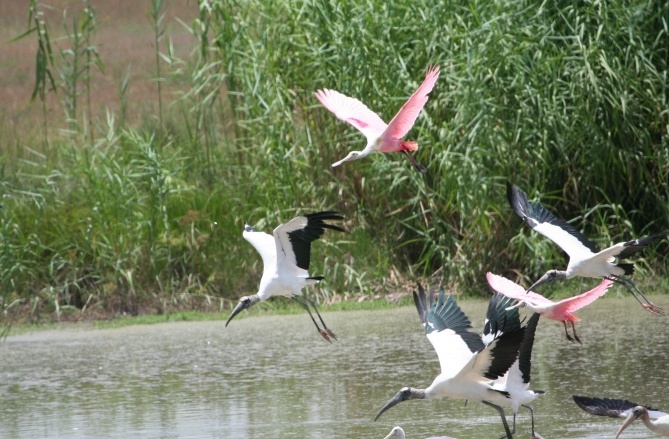
Roseate spoonbills & Woodstorks
This is Passport to Texas
Colonial Waterbirds gather on tiny islands dotted along the Texas Coast. Their beauty and diversity is attractive, but their populations have struggled over the years.
Colonial Waterbirds in the past experienced some pretty significant population declines.
Trey Barron is a Wildlife Diversity Biologist with Texas Parks and Wildlife.
A lot of the populations were down to almost nothing. Mainly due to overhunting. You know their feathers are very attractive and they were using them in stuff like hats.
Regulation changes and habitat improvements allowed many of the species to recover. But today there are new challenges like island erosion and exotic vegetation. Trey says one of the larger impacts, however, is human disturbance. Boaters, anglers and even photographers can get too close.
And they are disturbing these birds off of their nesting sites. Anytime that the birds get up, the young or the eggs are susceptible to predators. And some of those predators are other birds.
The more we can do to avoid disturbing these island habitats, the more successful Colonial Waterbirds can be.
The Wildlife Restoration Program supports our series and funds research for Colonial Waterbirds in Texas.
For Texas Parks and Wildlife…I’m Cecilia Nasti.
Posted in Birding, Conservation, Habitat | Comments Off on Keep Your Distance from Colonial Waterbirds
December 12th, 2019
![Running the board for a station that runs by the sun. [Image Courtesy of Sun Radio]](https://passporttotexas.org/wp-content/uploads/2019/10/intern_sun_radio.jpg)
Running the board for a station that runs on sun. [Image Courtesy of Sun Radio]
This is Passport to Texas
We all know that plants, wildlife and humans depend on energy from the sun to survive. TPWD even installed 25 solar photovoltaic systems at 17 of its own facilities.
But have you ever known a radio station run by the sun?
From the time the voice leaves the microphone until it gets to your listening device, it’s solar powered.
Sure, sure…this is off topic for our show, but—c’mon—to partner with nature to make radio is super cool. Daryl O’Neal is the executive director of Sun Radio, the first and largest non-commercial radio network powered by the sun.
We started looking around the landscape and noticed that all these small little non-commercial radio stations were off the air. We started trying to figure out okay well what if we could put them back on the air. Would it be a mission in doing that, bringing community radio back and what if we could also do it and be solar powered.
They are doing it: sending their signal to eleven different stations in Central Texas… but it’s not easy.
The real challenge we had is making sure that the solar power is consistent, because our equipment is very delicate. So, we had to put a lot of electric conditioning equipment in to make sure that DC feed that’s coming in is consistent. If you add up all of the kilowatts, it’s probably close to 75 to 80 thousand watts. Enough power on the ground to power the equipment in the air to send a signal out.
A signal that spreads like sunshine across Central Texas.
For Texas Parks and Wildlife…I’m Cecilia Nasti.
Posted in Conservation | Comments Off on Here Comes the Sun
December 11th, 2019
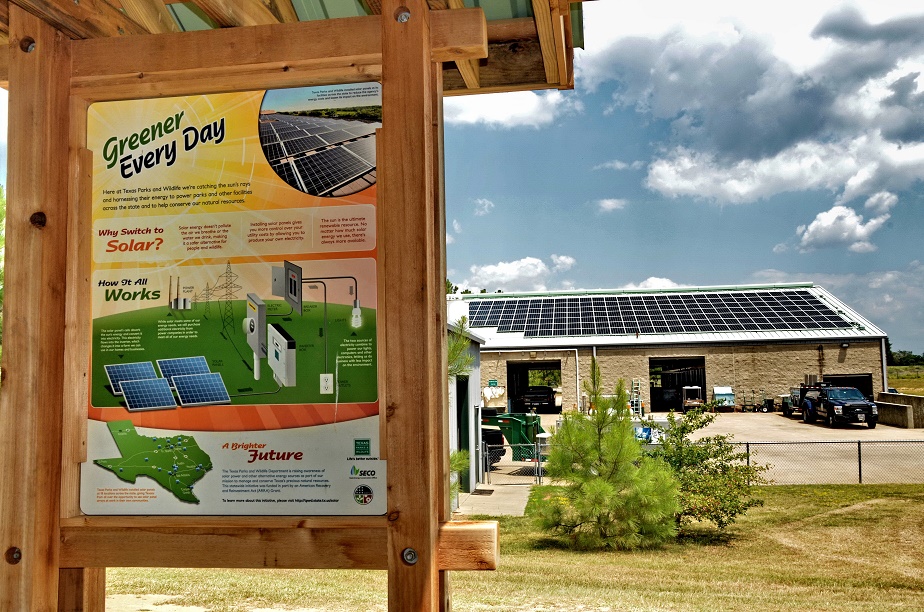
It’s getting easier to be green…
This is Passport to Texas
Texas Parks and Wildlife has been investigating renewable energy purchase options.
Through the State Energy Conservation Office there’s a group pulling together government entities to do a bulk purchase of renewable energy.
Andee Chamberlain is the Sustainability Program Manager at Texas Parks and Wildlife.
It’s really amazing our energy market in Texas, with all of the wind that is being produced, has really brought the renewable cost down. In the last contract that we negotiated, we looked at the cost of traditional energy vs renewable energy and the cost difference; about one percent. So it was negligible for us to choose renewable energy because it meets our mission.
The mission to “manage and conserve the resources of Texas for present and future generations” lends itself well to investment in renewable energy.
It makes a lot of sense for us to do that. All of the energy that we buy on the deregulated side is renewable; so that half of our sites are provided 100% renewable energy.
The bulk energy purchase contract will have a term of between ten and fifteen years.
That helps us not only support renewable energy but that helps us lock in a rate. And that’s really nice for parks to budget. Consistency is really important when your planning a park.
For Texas Parks and Wildlife…I’m Cecilia Nasti.
Posted in Conservation, Land/Water Plan | Comments Off on Renewable Energy at TPWD
December 10th, 2019
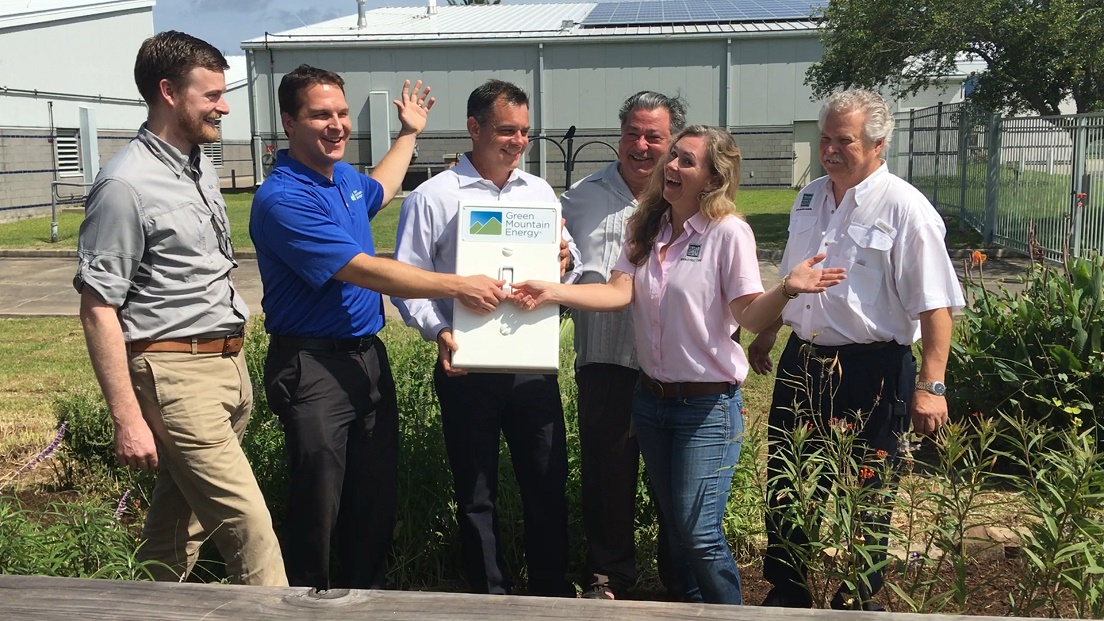
Turning on renewable energy with Green Mountain.
This is Passport to Texas
Since 2010 Texas Parks and Wildlife has been exploring renewable energy options such as solar and wind technologies
The state Energy Conservation office offered grants to state agencies who applied to install solar. They would pay for 80% of the project and we would pay for 20%.
Andee Chamberlain is the Sustainability Program Manager at Texas Parks and Wildlife.
It was just the right timing that we were able to apply for four separate grants totaling almost four million dollars. From that, we installed solar at over 20 facilities. Their utility bills went down, and that money is going back into the parks. And, those systems just keep operating. Once they are paid off, they keep providing benefits.
The agency has also investigated state-wide utility contacts serving sites in deregulated areas. In a deregulated market, the consumer chooses the retail provider.
So, we took that out to bid and Green Mountain Energy stepped up. We applied for a grant and got a solar installation at Enchanted Rock State Natural Area.
Additional grants provided funding to install solar equipment at Sea Center Texas; one of the agencies largest energy users.
What we’d rather do is spend money making parks more energy efficient so we use less operations dollars so we can redirect that money to offering a better experience for the park user.
For Texas Parks and Wildlife…I’m Cecilia Nasti.
Posted in Land/Water Plan | Comments Off on Sustainability at Parks and Wildlife


 Passport to Texas is a
  Passport to Texas is made available by: