Archive for the 'Endangered' Category

TPW Magazine–Big Horns & Paddling Trails

Wednesday, March 16th, 2011

This is Passport to Texas

The April issue of Texas Parks and Wildlife magazine is sure to intrigue and delight with stories that take you from one side of the state to the other. Editor, Louie Bond.

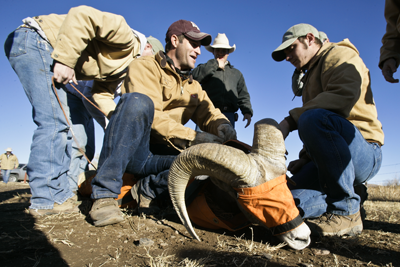
55—One thing in particular we’re going to look at is the bighorn sheep relocation out in West Texas, that happened in December, which was a glorious project, and very exciting for everyone who participated as they literally air lifted sheep from one location to another. But, it’s a great restoration project that the agency’s been working on for a long time, and we’re very proud. And I know that people are going to be so excited to drive down the road and be able to see a bighorn sheep again. In fact, I already had a friend tell me, ‘I saw a bighorn sheep out there the other day.’ So, it’s a great success story for all of us. Another great success story are the paddling trails that are opening up all around the state, due in large part to our partnerships with lots of great people across the state who want these paddling trails in their areas, and we help them make these a reality. So, people are getting out on the water and seeing the sights in this quiet, peaceful way of travel. So, I hope whether you like land or water, you’ll get outside and enjoy the great things our agency’s done this month.

Thanks, Louie.

Find more information at www.tpwmagazine.com.

We receive support from the Sport Fish and Wildlife Restoration Program…providing funding for wildlife restoration and water access.

For Texas Parks and Wildlife…I’m Cecilia Nasti

Helping Whooping Cranes

Friday, November 5th, 2010

This is Passport to Texas

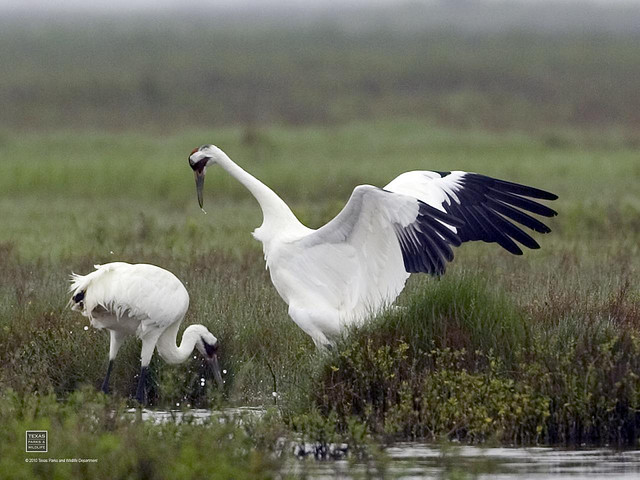
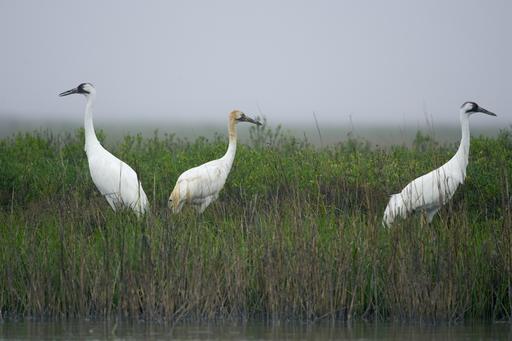
This month folks who reside in the Central Flyway of Texas may get a treat if they cast their gaze skyward, because whooping cranes are in migration.

18—Usually on a route down from the Muleshoe National Wildlife refuge area through the Hill Country and down to the coast. These birds are on migration so they’re on a pretty direct flight. And usually they’re moving during the day and they roost in good numbers at the various national wildlife refuges along the Central Flyway.

Mark Klym is with Wildlife Diversity. Whooping cranes are an endangered species, numbering slightly more than 260 birds—that’s up from a low of fewer than 20 animals in the early 20th Century.

Whoopers migrate in small groups of six or less, as well as on the fringes of migrating sand hill crane flocks. Klym asks that you contact him if you see these big birds along their migration path.

19—Once we’ve got a confirmation, our biologists use that to anticipate where we would see them next and try to follow them as they’re coming south to give us an idea if they’re going to run into any problems. You’ve got migratory bird hunting season at that time and we encourage the hunters to know what they’re shooting at. And, if there may be a problem, we may have to look at other actions to protect the birds.

We have the phone number for you to call to report seeing these birds at passporttotexas.org.

That’s our show…with support from the Sport Fish and Wildlife Restoration program… for Texas Parks and Wildlife …I’m Cecilia Nasti.
____________________________________________________

Whooping cranes are protected by federal and state endangered species laws, and Texans can help safeguard this national treasure by helping to prevent harm or harassment to whooping cranes. Anyone sighting a whooping crane is asked to report it to Texas Parks and Wildlife Department at (800) 792-1112, extension 4644 or alternatively at (512) 847-9480. Sightings can also be reported via e-mail at leeann.linam@tpwd.state.tx.us.

Whooping Crane Migration

Thursday, November 4th, 2010

This is Passport to Texas

This time of year when you look high overhead, you might just see whooping cranes.

10—Every year, about this time of year, we start getting emails and telephone calls from people all excited that they’ve seen whooping cranes flying over; and usually it’s between 50 and 100 birds.

But, Mark Klym, with the agency’s Wildlife Diversity program, says if you do witness a huge flock of big birds in the clouds…

07—I’m sorry, that’s not whooping cranes. Whooping Cranes never fly in a flock larger than about 10 birds, and very rarely more than six birds.

Well, maybe what you saw were sand hill cranes. Even so, North America’s biggest bird could still mingle in the mix.

05—Usually they’re off to the side. You’ll get the sand hills in a group and the whooping cranes off in a group on their own.

Whooping cranes, on the endangered species list, come through Texas’ Central Flyway this month on their way to the Aransas National Wildlife Refuge to overwinter.

15—We are optimistic that we are going to see a good population at Aransas National Wildlife Refuge. Certainly a recovery from what we saw in the past winter.

And what happened in the past winter?

Well, with the drought, we had very few blue crabs in the bays and as result suffered; we had a few losses.

If you do see whooping cranes in migration, contact Mark Klym. You’ll find his information at passporttotexas.org.

That’s our show…with support from the Sport Fish and Wildlife Restoration Program… for Texas Parks and Wildlife …I’m Cecilia Nasti.
_________________________________________________________

Whooping cranes are protected by federal and state endangered species laws, and Texans can help safeguard this national treasure by helping to prevent harm or harassment to whooping cranes. Anyone sighting a whooping crane is asked to report it to Texas Parks and Wildlife Department at (800) 792-1112, extension 4644 or, alternatively at (512) 847-9480. Sightings can also be reported via e-mail at leeann.linam@tpwd.state.tx.us.

Check out this YouTube video of whooping cranes at Aransas national Wildlife Refuge.

Black Bears Returning to East Texas

Wednesday, September 22nd, 2010

This is Passport to Texas

It’s a hog! It’s a dog! No! It’s a black bear?

[Bear calling]

Black bears are slowly coming back to East Texas from Louisiana, but Texas Parks and Wildlife Regional Director Nathan Garner says they might not be as easy to spot as you think.

We have so many things in East Texas that look exactly like black bears. For example black feral hogs at a distance can be easily misidentified as a black bear. We have black angus cattle, we have black dogs…

Well, you get the point. People may be so excited about the bears that they think they see them everywhere. In reality, there are only a handful of bears in East Texas forests at any given time. But Texas wildlife biologists investigate every sighting.

We go through a very rigorous process of following up those investigations with interviews and sight inspections.

Biologists can then collect physical evidence such as bear tracks, a piece of fur, or a picture taken by a motion-sensitive camera.

So even if you aren’t 100 percent certain you saw a bear, call Texas Parks and Wildlife, because, your call gives biologists a better idea of where the bears might exist. And, after all, you might just be right.

You can find more information at passporttotexas.org.

That’s our show… we had research and writing help from Gretchen Mahan…the Sport Fish and Wildlife Restoration program supports our series… For Texas Parks and Wildlife…I’m Cecilia Nasti.
Oiled Pelican Release

Wednesday, August 4th, 2010

This is Passport to Texas

[SFX brown pelicans calling]

Standing on the shore of the Aransas National Wildlife Refuge, wildlife veterinarian, Dan Mulcahy, called it a good day for pelicans affected by the oil spill in the gulf.

06—We’re here today to participate in the largest release of oiled pelicans following the oil spill to date.

In late June, 38 animals arrived at Rockport Airport via Coast Guard Jet from a Louisiana rehabilitation center. Their final destination: Aransas National Wildlife Refuge.

12—They were picked up here at the Rockport Airport by the staff of the Aransas National Wildlife Refuge and TPW, and were released as fast as we could undo the crates and let them go.

Once free, the birds gathered on the water away from shore and preened, which pleased Nancy Brown from the US Fish and Wildlife Service.

03—They can focus on preening as opposed to just surviving.

Texas offers abundant habitat for the pelicans. Yet, these iconic birds still aren’t out of danger. Any long-term health effects from their ordeal are yet unknown.

08—We look forward to coming out here next year and hopefully seeing these birds and hopefully they’re fatter and happier and doing well here on the Aransas National Wildlife Refuge.

Before their release, biologists placed a steel band with a unique ID on each bird’s leg to track our newest Texans into what will hopefully be a long and healthy future.

That’s our show… For Texas Parks and Wildlife…I’m Cecilia Nasti.