Archive for the 'Research' Category

Mid-winter Waterfowl Survey, 2

Friday, January 8th, 2010

This is Passport to Texas

To hunt ducks, you need to know where to find them.

People know where ducks typically are—along the coastal zone, maybe in the playa lake region of the Panhandle—but oftentimes they don’t think about these other places.

And those other places might surprise you, says Dave Morrison, waterfowl program leader at Parks and Wildlife.

Had we not been surveying places like the Blackland Prairies and Rolling Plains, people wouldn’t understand that there’s a large number of ducks in Texas on the stock tanks out in the central part of Texas. Sometimes we’ll see upwards of 800-thousand birds there. Those numbers actually, a lot of times, rival the numbers of ducks we count on the coast.

Biologists are presently conducting the annual mid-winter waterfowl survey, where they visually count and ID birds throughout the entire state, in a small plane 150 feet overhead. It helps them understand the birds’ movement, which they discovered is weather dependent.

You get conditions that are dry on the coast, but you get a hurricane that pushes a lot of water up on that brush country, puts a lot of water—guess what—a lot of ducks show up there….that otherwise people wouldn’t know they’re there. They say, well, the ducks aren’t here. Well, yeah they are. They just moved. Habitat conditions forced them into other areas. So, it gives us the ability to better understand where do birds go under different circumstances.

That’s our show…we receive support from the Wildlife restoration program…working to increase shooting and hunting in Texas.

For Texas Parks and Wildlife…I’m Cecilia Nasti.

Mid-winter Waterfowl Survery, 1

Thursday, January 7th, 2010

This is Passport to Texas

It’s time for the annual mid-winter survey of waterfowl.

Mid-winter surveys are pretty much a snapshot in time that states conduct every year the first week in January.

Dave Morrison is waterfowl program leader at Parks and Wildlife. He says the survey gives biologists an idea of how many of what species are “on the landscape.”

And, what it does for Texas, it gives us a comparison of what Texas has within the Central Flyway. Typically, when we do the mid-winter surveys, compared to the other nine states, seventy percent of the ducks are in Texas during that snapshot in time.

And this is good news for Texas duck hunters, because the survey can tell them where the ducks are.

It provides an opportunity for us, when people start questioning—well, there’s no ducks in Texas—well, we can say ‘no…here’s what it shows.” Because our surveys are designed to be able to detect changes over time. So, if there was a significant decline in numbers of ducks, we’d see it. But, by and large, we’d say, ‘well, they may not be where you’re at, but we know where they’re at. They’re over here.’

See what I mean? What factor moves ducks to unexpected locations? Find out tomorrow.

That’s our show…we receive support from the Wildlife Restoration Program…working to increase shooting and hunting in Texas.

For Texas Parks and Wildlife…I’m Cecilia Nasti.
Nature & Child Development, 1

Wednesday, December 16th, 2009

This is passport to Texas

Could spending more time in nature help kids with attention-deficit hyperactive disorder?

The research so far suggests that there’s a relationship between contact with nature or playing in green space and improvements in attentional functioning.

Dr. Andrea Faber Taylor researches child environment and behavior at the University of Illinois. In one study, she had children with ADHD take guided, 20-minute walks in a downtown area, a neighborhood, and a city park, and afterward, tested their ability to concentrate.

What we found was that after the children walked in the park they generally scored higher on the measure of attention. And surprisingly, the neighborhood and the downtown area were not significantly different in scores. That said to us, there’s something about the park that makes it, perhaps, more restorative than the other two settings.

Taylor’s findings match other research as well, which suggest it’s the setting, not just the activity, that’s important.

Based on our work and the work of others, we feel very confident that children benefit from contact with nature or even just what we call green space, a small pocket of trees and grass. Certainly, we’re not suggesting that it’s going to cure a child from ADHD, but it appears to, at least, temporarily reduce their symptoms.

That’s our show…For Texas Parks and Wildlife

Catfish: A Fish for Texas’ Future

Tuesday, November 24th, 2009

This is Passport to Texas

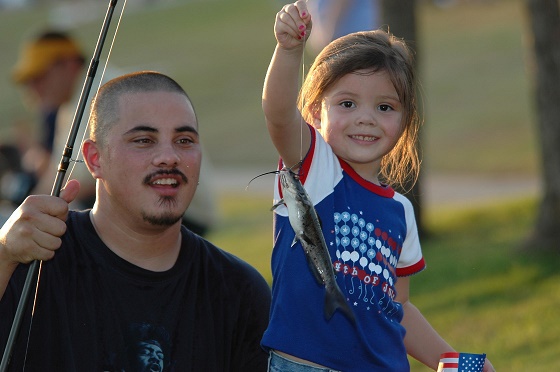
Texas is known for its bass angling, but chief of inland fisheries management and research, Dave Terre, says catfish angling is gaining popularity.

Today in Texas, about 50 percent of our anglers say they prefer largemouth bass. But, about 20 percent of anglers prefer fishing catfish in Texas.

Parks and Wildlife is meeting the challenge.

We’re trying to launch an initiative that will help us understand what our anglers needs and desires are for catfish angling in the state. And then study catfish more intensively to determine how we can make fishing for catfish even better.

September first, new regulations governing the harvest of blue catfish went into effect at Richland Chambers Reservoir, Lake Waco and Lake Lewisville—water bodies offering trophy potential for catfish. Find the regulations on the Parks and Wildlife website.

Meanwhile, Terre says as our climate changes, and extended droughts continue to plague our state, catfish will have an important role to play.

Catfish are able to deal with fluctuating water levels better than largemouth bass which have been, and will continue to be, a popular sport fish in Texas. So, managing catfish more intensively will mean that we may be able to provide more fishing opportunities for Texans in the future years.

Our show receives support from the Sport Fish Restoration Program…supporting fisheries research in Texas. For Texas Parks and Wildlife I’m Cecilia Nasti.

Recruiting a Few Good Prairie Chickens

Tuesday, November 17th, 2009

This is Passport to Texas

The military…corporate America…and sports teams all depend on good recruiting—something they have in common with the endangered Attwater’s Prairie Chicken.

Historically, this bird went through periods of time when a population would be devastated, and then it would recruit from neighboring populations.

But they’ve had to change their recruiting tactics, says Mark Klym, Adopt-a-Prairie Chicken Program coordinator.

Today those recruits have to come from the zoos.

Development destroyed the prairie chicken’s coastal habitat, reducing its population from a million birds at the turn of the 20th century to just 90 animals today—and that’s up from an all time low of 40 in 2005. Currently Three small populations are being maintained in the wild.

The bird is being reproduced for release. We are confident that we have enough birds that we can maintain these three populations now that we have in the wild. But there are biologists out there working with landowners every day trying to get land back in condition. And we have a number of landowners just waiting and asking for release of the birds on their land.

Klym maintains the Attwater’s Prairie Chicken will continue to rebound, and not go quietly into that good night.

We frequently get emails and calls asking when we expect this birds to go extinct. We don’t expect it to go extinct. This is going to be another good news story.

Learn about the adopt-a-prairie chicken program at passporttotexas.org. The Wildlife Restoration Program supports our series… For Texas Parks and Wildlife…I’m Cecilia Nasti.