Archive for the 'Research' Category

Conservation License Plates

Tuesday, December 7th, 2010

This is Passport to Texas

Ninety percent of the 12-hundred vertebrate species in Texas—that’s including fish—are non-game.

04—It doesn’t even include all the invertebrates that we have.

Invertebrates are estimated at 50-thousand. Matt Wagner, deputy Director for the Wildlife Division at Parks and Wildlife, says hunting and fishing license sales support conservation of game species and their habitats.

13—When you talk about non-game, and the species that aren’t hunted, there’s a lack of funding there. Although hunters have been paying for habitat work, we need to expand the number of folks that are contributing to conservation through their pocketbooks.

There are several ways for Texans to do that, and one way Wagner suggests celebrates a spiky Texas icon.

08—If you buy a horned lizard license plate for $30, $22 comes back to the agency to do non-game programs.

Sales of the horned lizard license plate generate between a quarter million to 300-thousand dollars annually.

12—We take that money, and then we leverage it with grants that come from the US Fish and Wildlife Service into the agency so that we can implement our Texas Conservation Action Plan.

Tomorrow: species that have benefited from Texans’ purchase of the conservation plate.

Our show receives support from the Sport Fish and Wildlife Restoration Program…funding the private lands and public hunting program.

For Texas Parks and Wildlife…I’m Cecilia Nasti.
Gulf Sampling After Oil Spill

Thursday, August 5th, 2010

This is Passport to Texas

During July, TPWD biologists collected environmental samples from along the Texas coast, creating a baseline record to gauge any impact in Texas from the Deepwater Horizon oil spill. We caught up with biologist Chip Wood on Galveston Island in early July.

38—We’re working on trying to establish the normal conditions that we see along our coastline.

We’re doing that by collecting sediment, water and biota samples—basically all the different little animals that live in the sand along in the beach, as well as going through and just surveying what the general characteristics of the beach are.

You know, how wide it is, you know, what types of plants or vegetation may be there, uh, if there’s any presence of any oil at all on the beach already from any other source. We started up in the Beaumont Port Arthur area earlier this week, and we hope, weather permitting, that we’ll be able to complete the entire Texas coast by the end of next week.

The team completed the task of sampling 21 stations along the Texas coast in just two weeks.

The effort is part of a plan developed by multiple natural resource trustee agencies in coordination with BP.

If you see oil in Texas waters or shorelines call the Texas General Land Office oil spill reporting line at 800-832-8224.

That’s our show… the Sport Fish and Wildlife Restoration program supports our series… For Texas Parks and Wildlife…I’m Cecilia Nasti.
TPW TV–Wind & Wildlife

Monday, March 8th, 2010

This is Passport to Texas

How do you balance the needs of wildlife and habitat, with wind energy? Find out this month and next on the TPW TV series: Producer Abe Moore.

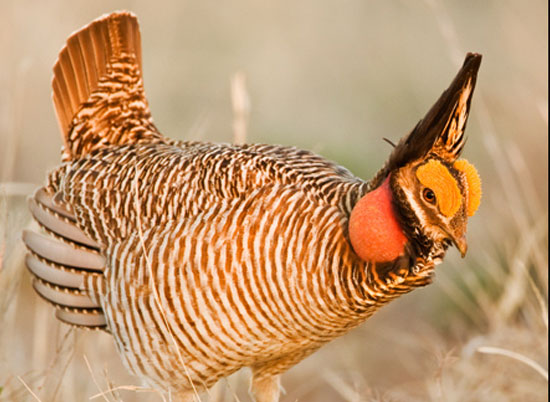
One of the areas we go is up in the Panhandle, where wind energy is threatening tall grass prairies and the Lesser prairie Chicken, which is there; and it’s got biologists a little concerned.

They don’t do well with change on the landscape. We think that we’re displacing or moving a nesting female away from where she wants to be, and we don’t have much habitat left for her to go to.

We also do a second part on wind energy and we go down to the coast, where wind energy is being developed even faster than in the Panhandle. And, it’s a concern because it’s in the Central Flyway where millions of birds migrate through. So you have all these birds and you’re putting wind turbines in there. So there’s a balance there. We talk with Penescal Wind Farm down there. And they have a radar system set up where they can see the birds coming before they get there.

The radar itself generates a curtailment command, and in less than one minute all the turbines will be turning at less than one RPM. And in within five minutes, all of them are completely stationary.

So, both on the coast, and on the Panhandle, it comes down to habitat issues and trying to site them in the right place.

That’s our show… with support from the Sport Fish and Wildlife Restoration Program…For Texas Parks and Wildlife…I’m Cecilia Nasti.
Guadalupe Bass–Solving the Hybrid Problem

Wednesday, February 10th, 2010

This is Passport to Texas

For more than a decade, researchers at the Heart of the Hills Fisheries Science Center in Kerrville have battled the hybrid progeny of Guadalupe bass—the state fish of Texas—and the introduced Smallmouth bass.

We’re raising thousands of pure Guadalupe bass here at the research station. And every year we stock them back into nature. Basically, what we’re doing is replacing the hybrids that are out there with these pure Guadalupe bass. And we’ll let nature take its course form there.

That’s Gary Garrett, who initiated the Guadalupe bass recovery program. The fish exists only in the Texas Hill Country—in the headwaters of streams that drain the Edward’s Plateau.

Shortly after non-native smallmouth bass were introduced to Texas waters, they bred with native bass, resulting in an explosion of hybrids. But using a technique called “saturation stocking,” Garrett and his crew have made exceptional progress.

So far we’re seeing here in Johnson Creek, where we began eh study, we started where 30 percent of the fish were hybrids. And that wasn’t stable—it was still increasing when we started. It is now down to around three percent. Which is excellent! Top go from thirty to three is great. Now we want to go from three to zero.

And Garrett expects to reach zero in the next four to five years.

That’s our show… we receive support from the SF Restoration program…For Texas Parks and Wildlife…I’m Cecilia Nasti.
Guadalupe Bass–A Hybrid Problem

Tuesday, February 9th, 2010

This is Passport to Texas

Some ideas seem good when you first have them. Then after some time passes—not so much. Take smallmouth bass, for example, and their effect on the Guadalupe bass population.

Small mouth bass, of course, are not native to Texas, but were brought in as an additional sport fish. The problem is they can’t tell each other apart. Even though they look very different, but evidently, they act similar enough behaviorally that they’ll reproduce—and they have hybrids.

That’s Gary Garrett, Director of the Watershed Conservation Program. So, what’s wrong with hybrids, anyway?

Hybrids, by definition, are halfway between the parents. So, they’re not as well adapted for their environment; they may do well in the short run, but in the long haul, they’re really not going to be as good a species.

Besides, they’re the state fish of Texas, occurring only in the Hill Country. And, well, you just don’t mess with Texas.

The other thing we’re now seeing a little bit is that these hybrids are now also crossing with our largemouth bass…which is yet another problem we want to avoid.

And you definitely don’t mess with largemouth bass. But, we’ve started to turn the tide on these hybrids with saturation stocking.

And we’re confident that in the next four or five years we’re going to be able to solve this problem.

That’s our show… we receive support from the SF Restoration program…For Texas Parks and Wildlife…I’m Cecilia Nasti.