Archive for the 'Saltwater' Category

Battling the Alligator Gar

Friday, October 28th, 2011

This is Passport to Texas

Alligator gar, virtually unchanged from prehistoric times, is attracting an enthusiastic 21st Century following.

:04—The species in recent years has become very popular amongst anglers and bow fishers.

David Buckmeier is a fisheries scientist for parks and wildlife. To fish for gar, you have to know where to find them.

:21—Most alligator gar are found in coastal rivers along the eastern part of the state; rivers like the Trinity are very, very well-known for their alligator gar populations. They’re also found in our coastal bays. They’re an interesting species in that they can go back and forth—maybe not into full salt water like in the gulf—but definitely in the bay systems. And they can go back and forth into the river and into those upper parts of those bays.

The alligator gar is the largest freshwater fish in Texas and gives anglers a good fight.

:16—Yes, they actually fight quite well. As you can imagine, any fish that weighs 150 or 200 pounds has a lot of power. So, they do fight; they actually jump quite a bit. They’ll completely clear the water. There’s some variations; some of them are more sluggish than others. But, they’re very entertaining and that’s the reason, I guess, for the popularity.

Anglers may keep one of these big fish per day. Lean more about freshwater fishing at the Texas parks and Wildlife website.

The Sport Fish and Wildlife restoration program supports our series…For Texas Parks and Wildlife…I’m Cecilia Nasti.
Blast from the Past: Alligator Gar

Thursday, October 27th, 2011

This is Passport to Texas

Evolution bypassed the alligator gar. Compare today’s gar to the fossil record, and the differences are insignificant.

:07—They’re often perceived as this very primitive, horrible fish that is kind of scary looking. So people, for that reason, have some fear of them.

David Buckmeier, a fisheries scientist for parks and wildlife, says this coastal river-dwelling freshwater fish is actually quite docile despite appearances.

The alligator gar is the largest freshwater fish in Texas, and can grow up to ten feet long and have the potential of tipping the scales at over three hundred pounds.

:11—They have a head shaped much like that of an alligator, hence the name. They are quite primitive; they have heavy bony scales all across their body, which are called ganoid scales. And it’s actual bone plates that protect that fish.

A behavior that some find unnerving is the gar’s tendency to linger at the water’s surface.

:21—Their gills aren’t advanced enough to get enough oxygen, especially when the water temperatures are warm. So, that’s why people will frequently see them at the top of the water; they’ll come up, gulp air then and go back down. So maybe, it’s not that their gills aren’t advanced enough, maybe they are evolving and they’re going to be crawling on the land soon. (laughs) Unlikely. They’ve been around for a long, long time, and they’ve been the same way.

Alligator gar is abundant in Texas, and is a sought after sport fish. More on that tomorrow.

The Sport Fish and Wildlife restoration program supports our series…For Texas Parks and Wildlife…I’m Cecilia Nasti.
Bay Seining

Monday, July 4th, 2011

This is Passport to Texas

We call searching the Internet surfing. But, we call searching a net that’s been in the surf, seining.

06—Seining is dragging a long net through the water, catching small fish and aquatic animals.

Hans Haglund is an interpretive ranger at Galveston Island State Park. He says the bay waters are teaming with all kind of life. And he’s taken more than a few visitors seining in Galveston Bay.

11—We do it to help educate about the bay, the wetlands, the environment out here; to show people how important they are, how productive they are, what these areas do for us, why we might need to protect them and look out for them.

Abundant, healthy wetlands can help to mitigate potential flood damage, as well as serve as nurseries for marine life. Haglund describes visitor reactions to what they catch in their seine nets.

09—Oh, I never know that was out there, and I never knew you could get so much in a little area. Even people that have been using the bay a lot – a lot of fishermen – don’t realize how productive these areas are.

Some of the more unusual fish Haglund says they see include the pipe fish and lizard fish.

Summer’s right around the corner and Galveston Island State Park offers a great coastal getaway. Learn more at texasstateparks.org.

The Sport Fish and Wildlife Restoration Program supports our series…and works to increase fishing and boating opportunities in Texas.

For Texas Parks and Wildlife…I’m Cecilia Nasti.
Artificial Reefs

Monday, June 27th, 2011

This is Passport to Texas

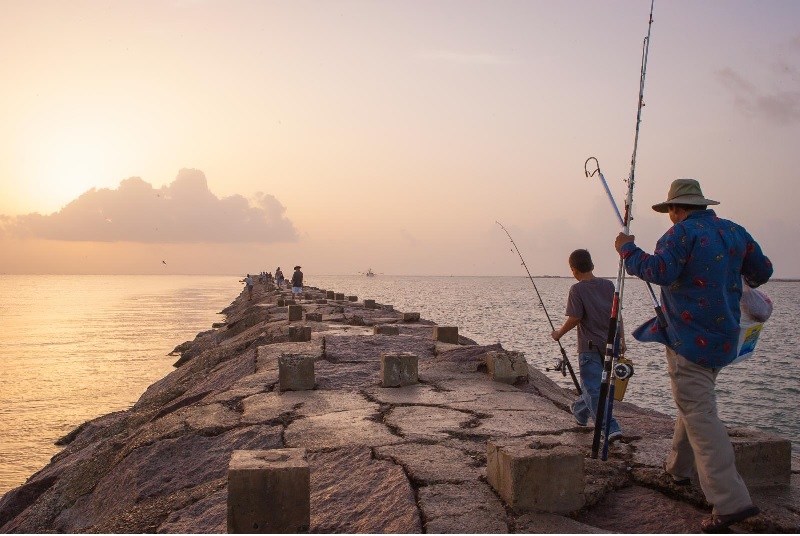
An artificial reef is marine habitat created by man and placed on the ocean bottom for the benefit of marine life.

12—Nature has a way of providing its own habitat, but in the case of the Gulf of Mexico – offshore Texas – most of the substrate is soft, murky, muddy, and there’s very little hard substrate out there.

Dale Shively coordinates the artificial reef program for Texas Parks and Wildlife. He says that hard substrate is necessary for the development of reefs. What’s fascinating is that once they deploy the substrate material, within days marine life begins attaching to it.

10—In a very short period of time, the substrate is covered with barnacles and sponges and some types of coral. And that begins the basis of the food web as we know it.

Without artificial reefs in the Gulf of Mexico, the waters wouldn’t be nearly as productive and vital as they are.

All kinds of items end up on the bottom of the gulf as artificial reefs: from oil rigs to concrete rubble to decommissioned battleships.

But what does any of this mean to the average Texan? Why should we care about this effort to create artificial reefs?

13—The importance of the reef program is, number one: preserve and enhance the marine environment. And by doing that, we also create fishing and diving opportunities for not only Texans, but also citizens throughout the US.

That’s our show for today…we receive support from the Sport Fish Restoration Program… funded by your purchase of fishing equipment and motor boat fuels.

For Texas Parks and Wildlife…I’m Cecilia Nasti.
TPW Magazine Goes Coastal

Monday, May 16th, 2011

This is Passport to Texas

Memorial Day weekend is the gateway to summer fun. And Texas Parks and Wildlife magazine editor Louie Bond says the June issue takes readers to the coast for a little fishing.

55—We sure are heading to the coast this month, Cecilia. You know, I guess people throughout our agency and throughout the state would argue about what the most exciting type of fishing is, whether it’s catching those big bass out in the lakes or fly fishing on the river…but for me, it’s being out there on the Gulf—what a tempestuous body of water, and what a challenge to fish out there. So, this month I have David Sykes from the Corpus Christi Caller Times and Larry Bozka; both well-known anglers and much to my delight both great writers. And so, we have dueling stories—both of conservation and sport fishing this month down on the lower Texas coast. And I’m excited to read about it. I still recall my favorite redfish experience: catching the biggest fish on the boat when I was eight months pregnant. Surprised a lot of the guys, I can tell you that. But, Larry will help us take a look at redfish, and David’s taking us for a look at that amazing sport fish—the tarpon. So, we hope that everybody will head down to the coast with us this month.

That’s our show…with funding from the Sport Fish restoration program, working to increase fishing and boating opportunities in Texas.

For Texas Parks and Wildlife…I’m Cecilia Nasti.